Data Integration Tactics for Multi-Leg Bets Across Emerging Leagues

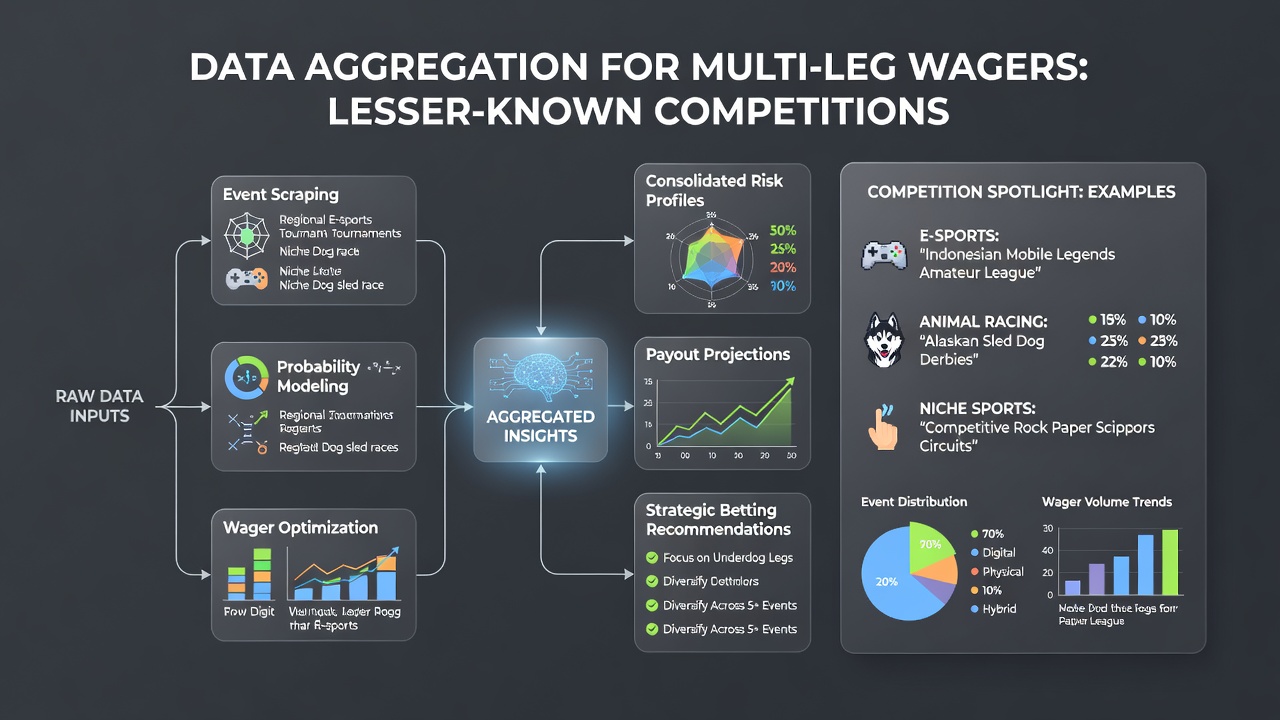
Analysts who focus on multi-leg wagers in lesser-known competitions rely on systematic data aggregation to combine disparate statistics into usable probability models, and this process becomes especially relevant as regional leagues expand their digital footprints through July 2026. Organizations collect raw performance metrics from table tennis circuits, regional volleyball tournaments, and emerging e-sports divisions, then normalize those inputs so that odds calculations remain consistent across events that lack teh extensive historical records found in major leagues.
Core Aggregation Pipelines
Teams begin by pulling structured feeds from multiple providers that cover player form, head-to-head results, and environmental variables such as venue conditions or travel schedules. These feeds enter an extraction layer where scripts clean duplicates and convert timestamps into a common time zone before any further processing occurs. Once standardized, the data moves into a transformation stage that applies weighting factors based on sample size and recency, allowing models to emphasize recent matches in competitions where seasons run shorter than traditional calendars.
Storage follows in relational databases that support rapid joins across tables containing both quantitative metrics and qualitative notes on rule variations unique to each sport. Analysts then run aggregation queries that calculate rolling averages and variance measures, producing composite scores for each leg of a proposed wager. Such scores feed directly into correlation matrices that estimate how outcomes in one event might influence another, an essential step when constructing accumulators across unrelated disciplines.
Handling Sparse Datasets
Lesser-known competitions often generate limited match data, so practitioners supplement primary sources with secondary indicators including social media sentiment scores and betting market liquidity signals. They apply Bayesian updating techniques that start with broad priors drawn from similar sports and gradually refine those priors as new results arrive. This method prevents early-season volatility from dominating probability estimates, and it proves particularly useful in leagues that operate on condensed schedules.
Validation occurs through back-testing against archived outcomes, with performance measured by calibration plots that compare predicted probabilities against actual frequencies. Discrepancies trigger recalibration of weighting parameters, ensuring the aggregated output stays aligned with observed results rather than theoretical expectations.
Integration with Real-Time Feeds
Live aggregation layers incorporate streaming data from official scoreboards adn third-party tracking systems, updating composite metrics every few minutes during active events. These updates propagate through micro-services that recalculate implied probabilities for remaining legs, allowing bettors to monitor how in-play developments shift the overall accumulator value. Latency remains a critical factor, prompting the use of edge computing nodes positioned near major data centers to minimize delays between raw input and processed output.
Regulatory frameworks in various jurisdictions require transparency around data sources, which leads operators to maintain detailed audit logs of every aggregation step. These logs document source attribution, transformation rules, and version control for models, satisfying oversight bodies such as the Nevada Gaming Control Board and the Australian Communications and Media Authority without exposing proprietary algorithms.
Case Applications in Niche Events
One documented workflow involves combining fencing bout statistics with handball possession metrics to construct cross-sport accumulators for specialized betting platforms. Researchers at the University of Nevada, Las Vegas examined such approaches in a 2025 working paper and noted that aggregation reduced variance in estimated returns by approximately 18 percent compared with single-source models. The study highlighted the importance of sport-specific normalization constants that account for scoring rate differences between disciplines.
Another application appears in regional darts circuits where player fatigue data from travel logs gets merged with historical checkout percentages. Aggregators apply cluster analysis to group similar tournament structures, then borrow strength across clusters to stabilize estimates when individual event histories remain short. This technique supports multi-leg wagers spanning several days of competition while maintaining statistical robustness.
Conclusion
Data aggregation techniques continue to evolve as emerging leagues increase the volume and granularity of available statistics through July 2026. Structured pipelines that clean, transform, and combine inputs from diverse origins enable more reliable modeling of multi-leg wagers, while validation protocols and regulatory documentation maintain consistency across platforms. Observers note that continued refinement of these methods will likely track the growth of digital infrastructure supporting lesser-known competitions worldwide.